
Note
Go to the end to download the full example code.
Run a Job#
This tutorial once again covers the essential high-level parts of creating and solving
problems with FElupe. This time, however, the external displacements are applied in a
ramped manner. The prescribed displacements of a cube under non-homogenous
uniaxial loading will be controlled within a
step. The
Ogden-Roxburgh pseudo-elastic Mullins softening model is
combined with an isotropic hyperelastic Neo-Hookean material
formulation, which is further applied on a
nearly incompressible solid body for a
realistic analysis of rubber-like materials. Note that the bulk modulus is now an
argument of the (nearly) incompressible solid body instead of the constitutive
Neo-Hookean material definition.
import felupe as fem

mesh = fem.Cube(n=6)
region = fem.RegionHexahedron(mesh=mesh)
field = fem.FieldContainer([fem.Field(region=region, dim=3)])

boundaries, loadcase = fem.dof.uniaxial(field, clamped=True)

umat = fem.OgdenRoxburgh(material=fem.NeoHooke(mu=1), r=3, m=1, beta=0)
body = fem.SolidBodyNearlyIncompressible(umat=umat, field=field, bulk=5000)
The ramped prescribed displacements for 12 substeps are created with
linsteps(). A Step is created with a list of items
to be considered (here, one single solid body) and a dict of ramped boundary
conditions along with the prescribed values.
move = fem.math.linsteps([0, 2, 1.5], num=[8, 4])
uniaxial = fem.Step(
    items=[body], ramp={boundaries["move"]: move}, boundaries=boundaries
)
This step is now added to a Job. The results are exported after each
completed and successful substep as a time-series XDMF-file. A
CharacteristicCurve-job logs the displacement and sum of reaction
forces on a given boundary condition.
job = fem.CharacteristicCurve(steps=[uniaxial], boundary=boundaries["move"])
job.evaluate(filename="result.xdmf", verbose=True)

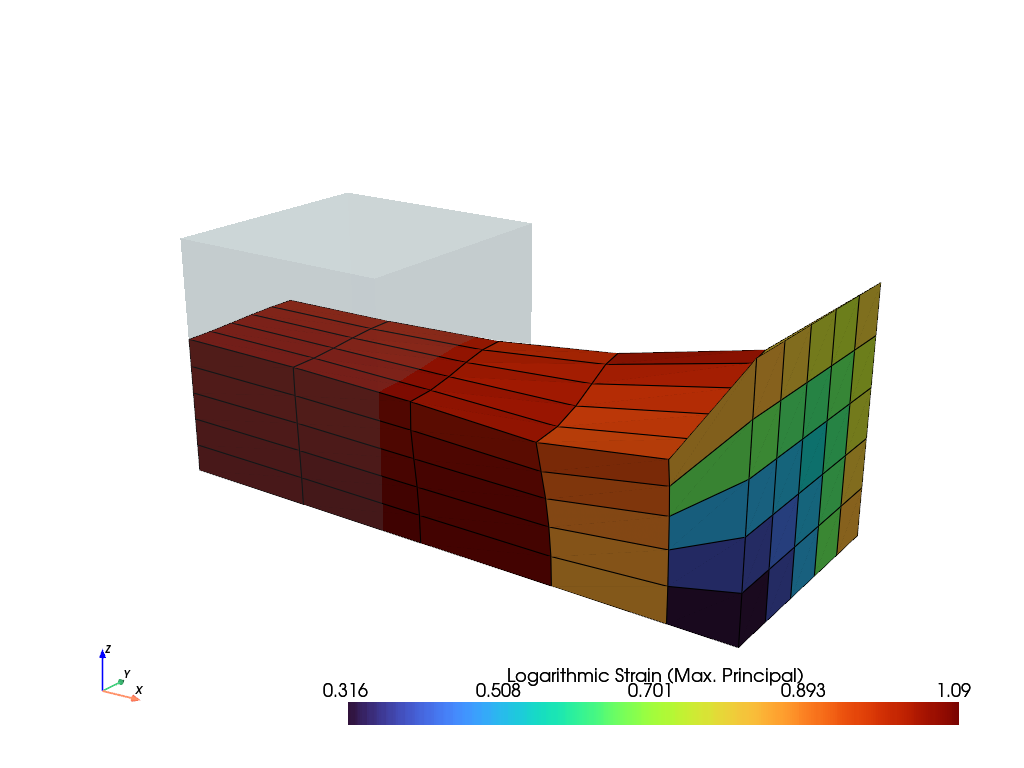
field.plot("Principal Values of Logarithmic Strain").show()
  0%|          | 0/13 [00:00<?, ?substep/s]
 15%|█▌        | 2/13 [00:00<00:01,  7.33substep/s]
 23%|██▎       | 3/13 [00:00<00:01,  6.06substep/s]
 31%|███       | 4/13 [00:00<00:01,  5.57substep/s]
 38%|███▊      | 5/13 [00:00<00:01,  5.28substep/s]
 46%|████▌     | 6/13 [00:01<00:01,  5.13substep/s]
 54%|█████▍    | 7/13 [00:01<00:01,  5.04substep/s]
 62%|██████▏   | 8/13 [00:01<00:01,  4.96substep/s]
 69%|██████▉   | 9/13 [00:01<00:00,  4.93substep/s]
 77%|███████▋  | 10/13 [00:02<00:00,  4.06substep/s]
 85%|████████▍ | 11/13 [00:02<00:00,  4.29substep/s]
 92%|█████████▏| 12/13 [00:02<00:00,  4.44substep/s]
100%|██████████| 13/13 [00:02<00:00,  4.56substep/s]
100%|██████████| 13/13 [00:02<00:00,  4.86substep/s]
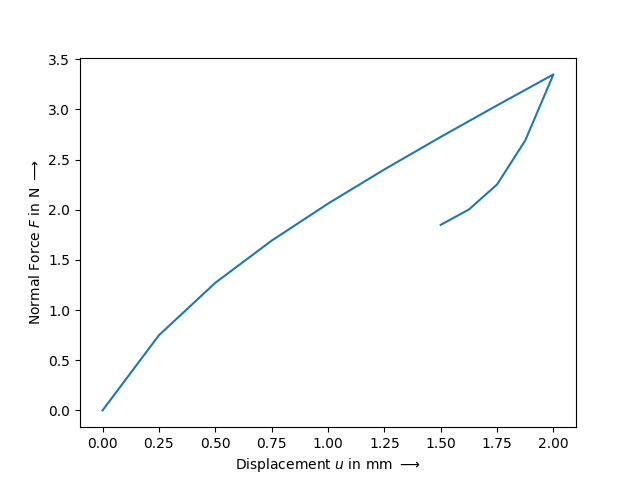
The sum of the reaction force in direction \(x\) on the boundary condition
"move" is plotted as a function of the displacement \(u\) on the boundary
condition "move" .
/home/docs/checkouts/readthedocs.org/user_builds/felupe/checkouts/v8.8.0/docs/tutorial/examples/extut02_job.py:2: SyntaxWarning: invalid escape sequence '\l'
  Run a Job
/home/docs/checkouts/readthedocs.org/user_builds/felupe/checkouts/v8.8.0/docs/tutorial/examples/extut02_job.py:3: SyntaxWarning: invalid escape sequence '\l'
  ---------
Total running time of the script: (0 minutes 3.477 seconds)