
Note
Go to the end to download the full example code.
Engine Mount#
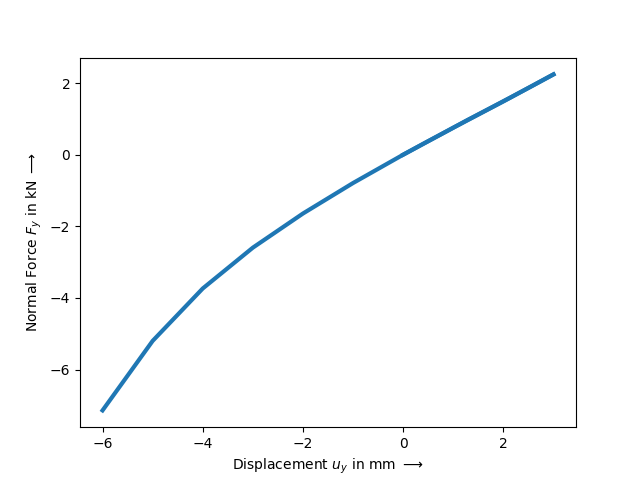
An engine-mount is loaded by a combined vertical and horizontal displacement. What is being looked for are the characteristic force-displacement curves in vertical and horizontal directions as well as the logarithmic strain distribution inside the rubber. The air inside the structure is meshed as a hyperelastic solid with no volumetric part of the strain energy function for a simplified treatment of the rubber contact. The metal parts are simplified as rigid bodies. Three mesh files are provided for this example:
a mesh for the rubber blocks as well as
a mesh for the air inside the engine mount.
import numpy as np

import felupe as fem

metal = fem.mesh.read("ex07_engine-mount_mesh-metal.vtk", dim=2)[0]
rubber = fem.mesh.read("ex07_engine-mount_mesh-rubber.vtk", dim=2)[0]
air = fem.mesh.read("ex07_engine-mount_mesh-air.vtk", dim=2)[0]
Sub-regions and fields for all materials are generated. The sub-fields must be merged to generate both the displacement fields for metal / rubber / air and a top-level displacement field.
The boundary conditions are created on the global displacement field. First, a mask for all points related to the metal parts is created. Then, this mask is splitted into the inner and the outer metal part. The global field holds a mesh-container attribute which may be used for plotting.
mesh = field.region.mesh
x, y = mesh.points.T
radius = np.sqrt(x**2 + y**2)

only_cells_metal = np.isin(
    np.arange(mesh.npoints), np.unique(fields[0].region.mesh.cells)
)
inner = np.logical_and(only_cells_metal, radius <= 45)
outer = np.logical_and(only_cells_metal, radius > 45)

boundaries = fem.BoundaryDict(
    fixed=fem.Boundary(field[0], mask=outer),
    u_x=fem.Boundary(field[0], mask=inner, skip=(0, 1)),
    u_y=fem.Boundary(field[0], mask=inner, skip=(1, 0)),
)
plotter = field.mesh_container.plot(colors=["grey", "black", "white"])
boundaries.plot(plotter=plotter, scale=0.02).show()

The material behaviour of the rubberlike solid is defined through a built-in
hyperelastic isotropic compressible Neo-Hookean material formulation. A solid body
applies the material formulation on the displacement field. The air is also simulated
by a Neo-Hookean material formulation but with no volumetric contribution and hence,
no special mixed-field treatment is necessary here. A crucial parameter is the shear
modulus which is used for the simulation of the air. The air is meshed and simulated
to capture the contacts of the rubber blocks inside the engine mount during the
deformation. Hence, its overall stiffness contribution must be as low as possible.
Here, 1 / 25 of the shear modulus of the rubber is used. The bulk modulus of the
rubber is lowered to provide a more realistic deformation for the three-dimensional
component simulated by a plane- strain analysis.
shear_modulus = 1
rubber = fem.SolidBodyNearlyIncompressible(
    umat=fem.NeoHooke(mu=shear_modulus), field=fields[1], bulk=100
)
air = fem.SolidBody(umat=fem.NeoHooke(mu=shear_modulus / 25), field=fields[2])
After defining the consecutive load steps, the simulation model is ready to be solved. As we are not interested in the strains of the simulated air, a trimmed mesh is specified during the evaluation of the characteristic-curve job. The lateral force- displacement curves are plotted for the two different levels of vertical displacement.
thickness = 100
vertical = fem.Step(
    items=[rubber, air],
    ramp={boundaries["u_y"]: fem.math.linsteps([0, 3], num=3)},
    boundaries=boundaries,
)
job = fem.CharacteristicCurve(steps=[vertical], boundary=boundaries["u_y"]).evaluate(
    x0=field, tol=1e-1
)
figv, axv = job.plot(
    xlabel=r"Displacement $u_y$ in mm $\longrightarrow$",
    ylabel=r"Normal Force $F_y$ in kN $\longrightarrow$",
    xaxis=1,
    yaxis=1,
    yscale=1 / 1000 * thickness,
    ls="-",
    lw=3,
)

horizontal = fem.Step(
    items=[rubber, air],
    ramp={boundaries["u_x"]: 8 * fem.math.linsteps([0, 1, 0, -1, 0], num=8)},
    boundaries=boundaries,
)
job = fem.CharacteristicCurve(steps=[horizontal], boundary=boundaries["u_y"]).evaluate(
    x0=field, tol=1e-1
)
figh, axh = job.plot(
    xlabel=r"Displacement $u_x$ in mm $\longrightarrow$",
    ylabel=r"Normal Force $F_x$ in kN $\longrightarrow$",
    yscale=1 / 1000 * thickness,
    lw=3,
    color="C0",
    label=r"$u_y=+3$ mm",
)

vertical = fem.Step(
    items=[rubber, air],
    ramp={boundaries["u_y"]: fem.math.linsteps([3, 0, -6], num=[7, 6])},
    boundaries=boundaries,
)
job = fem.CharacteristicCurve(steps=[vertical], boundary=boundaries["u_y"]).evaluate(
    x0=field, tol=1e-1
)
figv, axv = job.plot(
    xaxis=1,
    yaxis=1,
    yscale=1 / 1000 * thickness,
    ls="-",
    lw=3,
    color="C0",
    ax=axv,
)
horizontal = fem.Step(
    items=[rubber, air],
    ramp={boundaries["u_x"]: 5 * fem.math.linsteps([0, 1, 0, -1], num=5)},
    boundaries=boundaries,
)
job = fem.CharacteristicCurve(steps=[horizontal], boundary=boundaries["u_y"]).evaluate(
    x0=field, tol=1e-1
)
figh, axh = job.plot(
    yscale=1 / 1000 * thickness,
    lw=3,
    color="C1",
    label=r"$u_y=-6$ mm",
    ax=axh,
)
axh.legend()

The maximum principal values of the logarithmic strain tensors are plotted on the deformed configuration. The displacement field of the metal parts was not used and must be linked manually to the top-level field.

Total running time of the script: (0 minutes 5.204 seconds)